
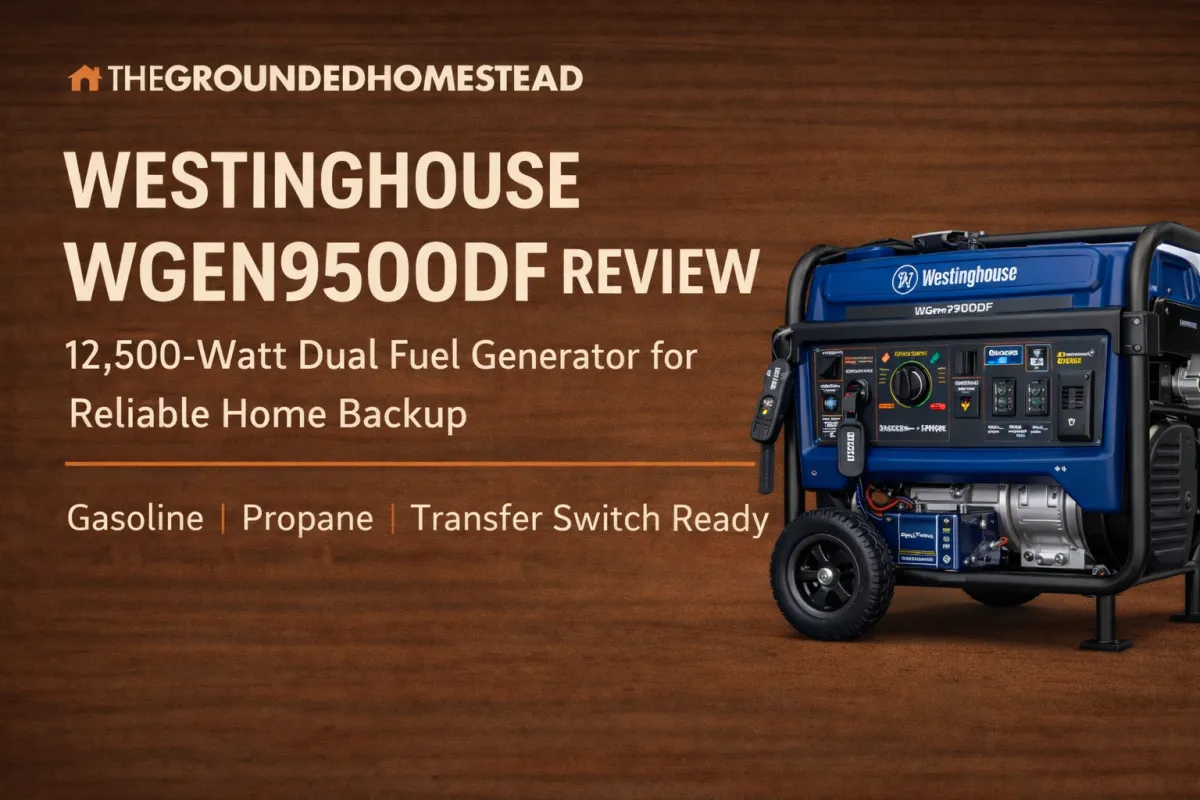
Westinghouse WGen9500DF Portable GeneratorReview
Westinghouse WGen9500DF Review (12,500 Peak Watt Dual Fuel Portable Generator)
If you’ve ever watched the lights flicker during a winter windstorm—or you’ve had a freezer full of food and a forecast you don’t trust—you already know the feeling: you don’t need “a generator.” You need a plan that works when everything else doesn’t.
This review covers the Westinghouse WGen9500DF, a dual fuel (gasoline + propane) portable generator built for home backup, transfer switch hookups, and the kind of real-world use where reliability matters more than marketing.
Amazon link: Westinghouse 12,500 Watt Dual Fuel Home Backup Portable Generator (WGen9500DF)
Product Description
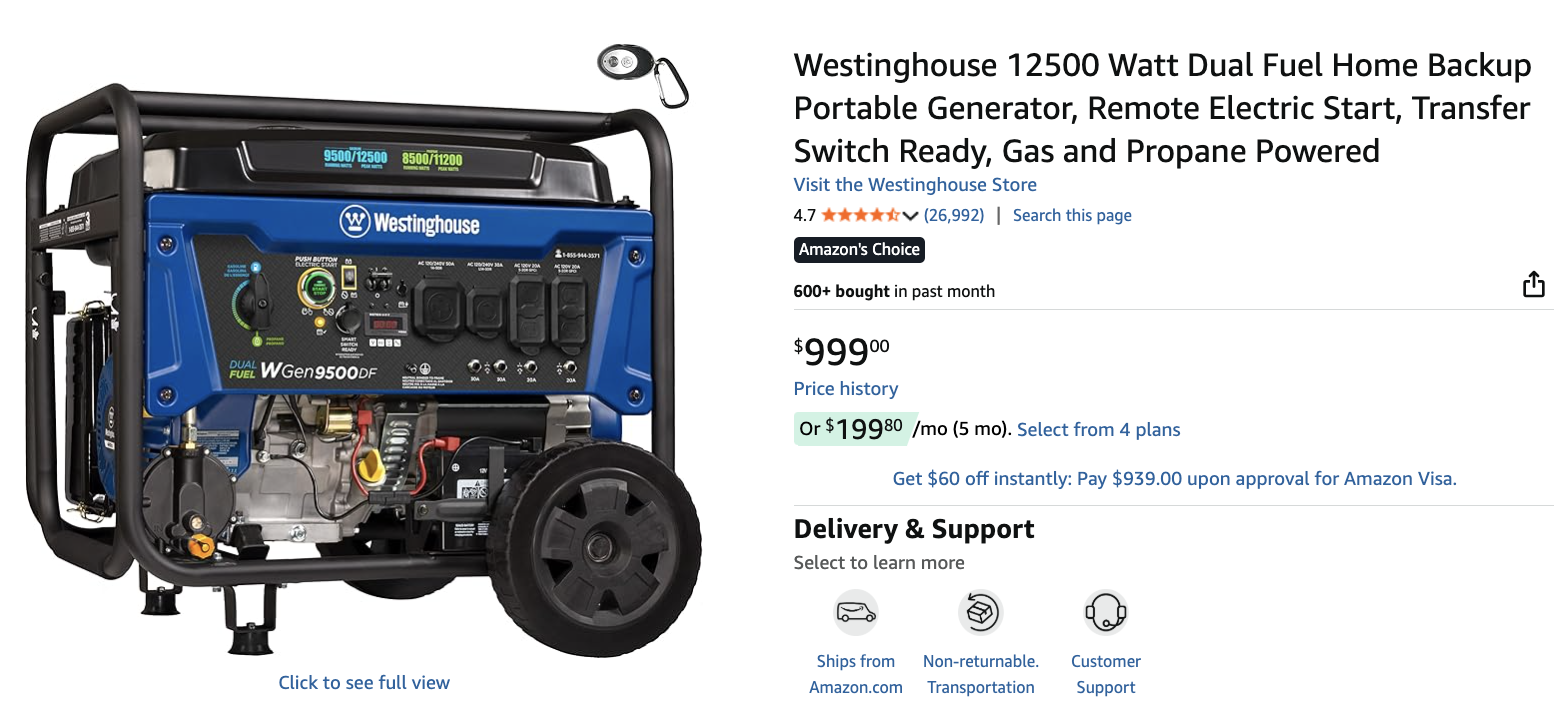
The Westinghouse WGen9500DF is a heavy-duty, open-frame generator designed to deliver 9,500 running watts and up to 12,500 peak watts on gasoline (with slightly lower output on propane). It’s built for home backup and offers the features most people actually want during an outage: electric start, remote start, fuel gauge, hour meter, and transfer switch-ready outlets.
It’s also a true “set it up once, then keep it ready” type of machine—especially if you’re planning to run essentials like a refrigerator/freezer, well or sump pump, furnace fan, lights, and some basic household circuits.
Key Specs
Output (Gasoline):
9,500 running watts
12,500 peak watts
Output (Propane):
8,500 running watts
11,200 peak watts
Engine:
457cc 4-stroke OHV Westinghouse engine
Cast iron sleeve (durability-focused design)
Fuel & Runtime:
6.6-gallon fuel tank
Up to 12 hours runtime (gas) depending on load
Built-in fuel gauge
Start Options:
Remote start (key fob included)
Push-button electric start
Recoil start backup
Outlets (high value for home backup):
Two GFCI 120V 5–20R household outlets
One 120V L14-30R (30A) transfer switch-ready
One 120/240V 14–50R (50A) transfer switch-ready / RV-ready
Rubber outlet covers for added protection
Monitoring & Protection:
Automatic voltage regulation
Digital hour meter
VFT display: voltage output, frequency, lifetime hours
Low oil shutdown
Weight:
210 lbs (this is a big unit—plan for it)
Included components:
Battery charger
Engine oil & funnel
Key fob
Propane hose
Quick-start guide + manual
Tool kit
Warranty paperwork
Build & Materials (what it feels like in real life)
This is not a “toss it in the trunk” generator. The WGen9500DF is a serious, heavy, steel-frame machine with the kind of footprint and weight you’d expect from something meant to push transfer-switch-level power.
A few build details that matter:
The 457cc engine and cast iron sleeve are aimed at longevity.
The frame and layout are “jobsite tough” more than “pretty.”
The included never-flat wheels + handle kit are not optional in real life—at 210 lbs, you’ll use them.
If you’re putting this on gravel, uneven ground, or a packed-dirt path out to a shed, the built-in mobility setup is a big deal.
Ideal Users & Use Cases
This generator makes the most sense for:
Homeowners who want real outage coverage, not just phone-charging power
People with transfer switches (30A or 50A) or plans to install one
Rural or semi-rural properties running freezers, well pumps, sump pumps, furnace blowers
Anyone who values propane as a long-term storage fuel, but still wants gas flexibility
Folks who want the convenience of remote start and push-button start (especially in bad weather)
It’s also useful for:
Jobsite power where you need high output
RV or travel trailer use if you’ve got the right cords/inlet setup (and you understand load management)
Standout Features vs. Typical Competition
1) Dual Fuel Flexibility (Gas + Propane)
Propane gives you storage stability (it doesn’t go stale like gasoline) and can be a smart long-term outage plan—especially if you already keep propane on hand.
The ability to switch fuels adds flexibility when:
gas stations are down,
fuel deliveries are delayed,
or you want cleaner-running fuel for maintenance reasons.
2) Remote Start + Electric Start
During a storm, remote start is more than convenience—it’s less hassle and less exposure.
You get:
remote start via key fob,
push-button electric start,
and recoil start as backup.
That’s three layers of “this thing will start,” which matters when you actually need it.
3) Transfer Switch-Ready Outlets (30A + 50A)
A lot of generators talk about “home backup,” but don’t give you the outlet layout you need.
This one includes:
L14-30R (30A) for transfer switches,
14-50R (50A) for bigger hookups / RV-ready setups.
If your goal is powering home circuits safely through a transfer switch or inlet box, this is the correct direction.
4) Monitoring That Actually Helps
The hour meter + VFT display gives you real-time feedback so you can:
track maintenance intervals,
monitor voltage/frequency,
and make smarter load decisions during use.
From the Manufacturer

Westinghouse positions the WGen9500DF as a dual fuel, high-output home backup generator with start convenience (remote + electric), long runtime on a 6.6-gallon tank, and transfer switch readiness for powering major appliances. It’s built around a durable 457cc OHV engine with a cast iron sleeve, and includes key accessories to get running quickly (oil, funnel, propane hose, tools, battery charger).
Review Highlights (what owners consistently praise)
Here’s the trend line across reviews:
Recurring Praise
Starts right up out of the box (multiple people mention easy first start)
Remote start is genuinely useful (works from inside the house for many users)
Good build quality (feels solid, heavy-duty, “beast” / “powerhouse” language comes up often)
Easy assembly (wheels/feet/handle + battery connection is straightforward)
Strong value for the power (many buyers compare it favorably to higher-priced units)
Real-world notes that show up often
People like that it includes oil + funnel + basic tools
Owners appreciate the printed manual and clear warnings (oil first, exhaust precautions)
Several mention it runs smoothly and handles household loads well when paired with the right hookup
Negative Reviews & Common Complaints (what to watch)
Even a well-reviewed generator has patterns you should know.
1) It’s heavy
At ~210 lbs, this is not “portable” in the casual sense. It’s movable on wheels, but:
uneven ground can be a pain,
loading into a truck is not a solo job for many people.
2) Noise is subjective (and often loud)
Some people say it’s quieter than expected for its size, but others call it loud. Open-frame generators are rarely “quiet.” If noise matters:
placement, distance, barriers, and enclosure planning are part of the purchase decision.
3) High-altitude users may need a kit
A handful of users at higher elevation mention needing high altitude carb/regulator solutions. If you live above roughly 2,000 feet, plan for that possibility.
4) Shipping/handling issues can happen
A few reviews describe shipping complications or small issues that required troubleshooting. Not constant—but it shows up.
Pros & Cons
Pros
Big, usable power (9,500 running / 12,500 peak on gas)
Dual fuel flexibility (gasoline + propane)
Remote + electric + recoil start (redundancy matters)
Transfer switch-ready outlets (30A and 50A options)
Solid monitoring (hour meter + VFT display)
Good included kit (oil, funnel, tools, propane hose, charger)
Cons
Heavy (210 lbs) — plan storage and positioning
Open-frame noise — can be loud depending on expectations
Altitude considerations — may require jet/regulator adjustments
Setup still requires basic assembly (not hard, but it’s not “ready assembled”)
Video Tutorial
FAQ
Q1: Can it run on propane and gasoline?
A1: Yes. It’s a dual fuel generator designed to run on gasoline or propane (LPG).
Q2: Can it connect to a transfer switch?
A2: Yes. It includes a 120V L14-30R (30A) transfer switch-ready outlet and a 120/240V 14-50R (50A) outlet for larger hookups.
Q3: Does it have remote start?
A3: Yes. It includes a remote start key fob, plus push-button electric start and recoil backup.
Q4: How long will it run?
A4: The product page notes up to 12 hours on the 6.6-gallon tank depending on load.
Q5: Is it safe for sensitive electronics?
A5: It includes automatic voltage regulation and monitoring (VFT display), but if your priority is ultra-clean power for highly sensitive electronics, some users prefer inverter generators. For typical household circuits, owners report strong performance.
Q6: Is it easy to move?
A6: It has wheels and a handle, but it’s still 210 lbs. On flat surfaces, it’s manageable. On rough ground, you’ll feel the weight.
Final Verdict
The Westinghouse WGen9500DF is the kind of generator you buy when you’re done playing games with outages. It’s built for real home backup power, gives you dual fuel flexibility, and checks the boxes that matter in the moment: starts easily, hooks up correctly, runs hard, and keeps going.
If you want a portable generator that can legitimately support your home through outages—and you’re willing to manage the weight and noise that comes with this power class—this is a strong pick.
Amazon link: Westinghouse WGen9500DF Dual Fuel Portable Generator (12,500 Peak Watts)
Links to product are Amazon affiliate links. We receive a small percentage at no additional cost to you. We appreciate your support! Thank you!
Bibliography (sources used)
Amazon product listing: Westinghouse 12,500 Watt Dual Fuel Home Backup Portable Generator (WGen9500DF)


Facebook
Instagram
X
Youtube