
Choosing Trees and Tapping Right: Maples, Size, and Long-Term Health
Choosing Trees and Tapping Right: Maples, Size, and Long-Term Health
The First Hole You Can’t Undo
I remember the first time I truly understood tapping damage. I was standing in the snow with a cordless drill, staring at a healthy maple, telling myself the same lie almost everyone does at the start: it’s just one hole.
Here’s the truth most beginners don’t hear early enough—every tap hole is permanent. The tree doesn’t heal through it. It heals around it. That hole becomes part of the tree’s internal history, triggering compartmentalization, redirecting sap flow, and permanently altering how that section of sapwood functions.
This is where any good maple tree tapping guide has to start. Before tools, before spiles, before yield math.
You don’t get do-overs. You don’t get to “fix it next year.” Every decision you make—drill depth, drill angle, tap hole placement, restraint in tap count—echoes forward for decades inside that tree.
If you want to know how to tap maple trees correctly, it starts with accepting this: tapping is not harvesting in the moment. It’s a long-term relationship. Push too hard now, and the damage shows up later as reduced yield, slower wound closure, internal decay, and stressed crowns that never quite recover.
This post exists to help you avoid irreversible mistakes—the quiet kind. The ones that still give syrup for a few years while slowly shortening the productive life of your sugar bush.
Maple syrup rewards patience.
It punishes shortcuts.
Not All Maples Are Created Equal
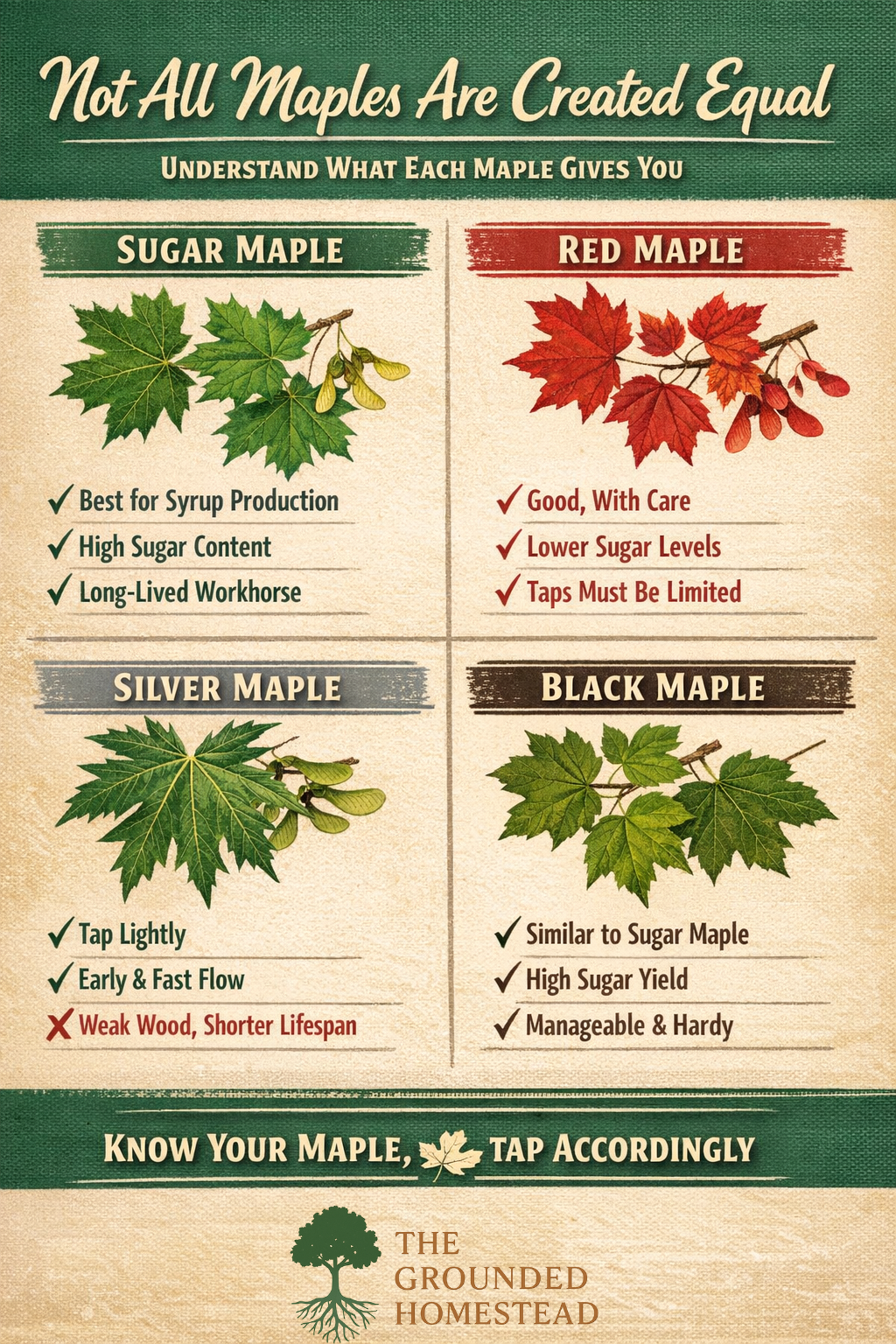
If you learn nothing else from this maple tree tapping guide, learn this: species choice determines everything downstream—from sap sugar content and total yield to how much abuse a tree can tolerate before it starts to decline.
If you’re serious about learning how to tap maple trees correctly, you don’t start with the drill. You start by choosing the right trees.
Sugar Maple (Acer saccharum): The Gold Standard
Sugar maples are the backbone of long-term syrup production for a reason.
Highest sap sugar content, often 2–3%
Consistent flavor year to year
Dense wood with strong sapwood structure
Better wound closure after tapping
Long productive lifespan when tapped with restraint
Sugar maples handle tap holes better than any other species. Their internal structure limits spread of decay and allows cleaner compartmentalization around old holes.
If you’re building a sugar bush with longevity in mind, this is your first-choice species—every time.
Red Maple (Acer rubrum): Productive but Conditional
Red maples can produce syrup, but they demand discipline.
Lower sugar concentration than sugar maples
Often rely on higher sap volume to offset lower sugar
More sensitive to over-tapping and poor hole rotation
Red maples make sense when:
Sugar maples are limited
Trees have adequate diameter (DBH) and healthy crowns
You accept slightly lower efficiency in exchange for access
What they don’t tolerate is aggressive tapping. Poor drill depth, excessive taps, or sloppy sanitation accelerates internal stress quickly.
Silver Maple (Acer saccharinum): Fast Growth, Faster Problems
Silver maples tempt beginners because the sap runs hard—but that’s where the good news ends.
Very low sugar content
Soft wood prone to internal decay
Weaker compartmentalization response
Structural issues increase long-term risk
Silver maples flow heavily during strong freeze–thaw cycles, but their heartwood is easily damaged. One bad season of over-tapping can cause problems that never fully resolve.
Tap sparingly—or don’t tap at all.
Black Maple (Acer nigrum): The Sleeper
Often confused with sugar maples, black maples are excellent producers when identified correctly.
Sugar content comparable to sugar maple
Slightly different leaf structure
Strong long-term yield potential
If you have black maples, treat them like sugar maples. They’re worth protecting.
If you’re ever unsure which maple you’re standing in front of, a reliable tree identification guide is one of the best long-term investments you can make before ever picking up a drill.
Avoid This Mistake:
“Maple is maple.” It isn’t. Choosing the wrong species forces you to push harder later—and that pressure always shows up in reduced yield and tree health.
Quick Comparison of Maple Trees

Minimum Trunk Size (DBH) and Safe Tap Limits for Maple Trees
This is where most long-term damage actually occurs—not from bad equipment, not from drilling technique, but from tapping trees that aren’t ready or pushing trees past what their structure can support.
If you want to follow a maple tree tapping guide that protects long-term yield, this section matters more than anything else you’ll do with a drill.
For a broader understanding of how sap flow, sugar concentration, and tree health work together across the entire season, see Maple Syrup 101.

DBH Rules (Diameter at Breast Height)
DBH (diameter at breast height) is measured 4.5 feet off the ground. It tells you how much functional sapwood a tree has available to safely support a tap hole.
Use these rules as hard limits for long-term tree health:
Under 10 inches DBH:
Never tap. The sapwood layer is too thin to tolerate damage.10–17 inches DBH:
One tap maximum. More than that overwhelms wound closure capacity.18–24 inches DBH:
Two taps only, spaced properly with correct hole rotation.Over 25 inches DBH:
Two taps still. A third tap is almost never justified and often accelerates internal stress.
While some charts allow a third tap in exceptionally large, healthy sugar maples, research and long-term producer experience consistently show diminishing returns and increased internal stress beyond two taps.
Yes, you can physically drill more holes. That doesn’t mean the tree can biologically handle them.
Why DBH Matters More Than Age
Age doesn’t heal tap holes—structure does.
Smaller trees have:
Less functional sapwood
Slower wound closure
Reduced ability to compartmentalize damage
When a tree can’t wall off a tap hole, internal decay spreads vertically through the trunk, quietly shrinking usable sapwood year after year.
The Over-Tapping Temptation
This is where yield math lies to you.
Adding another tap increases sap flow this season.
It often costs you years of future yield.
Trees under repeated stress respond by limiting sap movement around damaged zones. That reduces usable sapwood and increases susceptibility to rot—especially when sanitation or hole rotation is sloppy.
Over-tapped trees don’t usually fail fast.
They decline slowly, producing less syrup each year until they’re no longer worth tapping.
Pro Tip: If you’re asking whether a tree can handle another tap, it probably can’t. Restraint protects yield better than aggression ever will.
For a deeper, industry-standard reference on DBH tap limits and tree health, the North American Maple Syrup Producers Manual is the go-to technical backbone.
Where to Drill: Proper Tap Hole Placement for Maple Trees
Tapping isn’t guesswork. It’s controlled damage. If you want to know how to tap maple trees correctly, this is where technique protects—or destroys—everything you did right up to this point.
Poor drill angle, sloppy drill depth, or careless tap hole placement won’t always show up immediately. But inside the tree, those mistakes interfere with sap flow, slow wound closure, and invite long-term decay.
Drill Angle
Your drill angle determines whether sap flows cleanly or pools inside the tree.
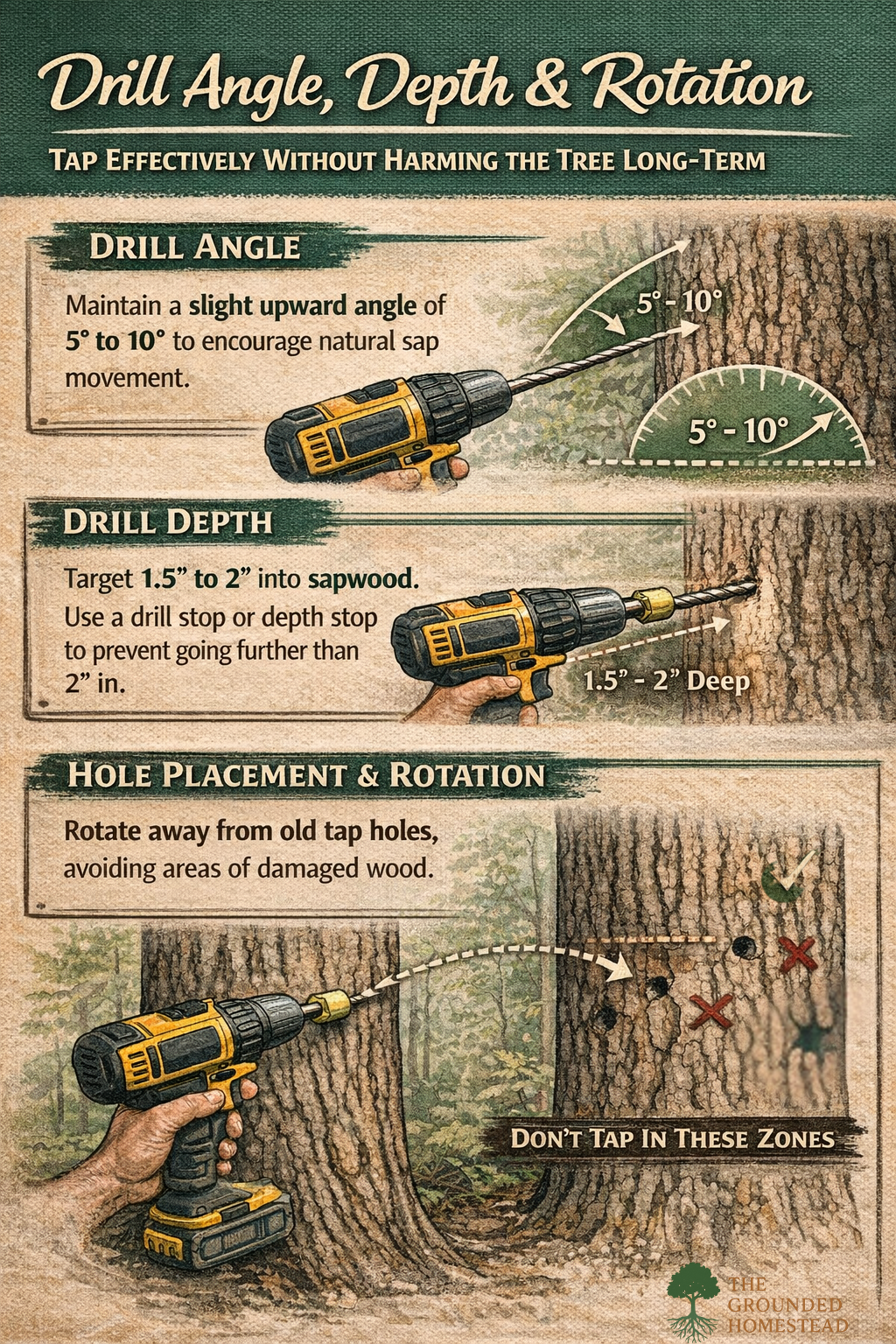
Drill at a slight upward angle—about 5–10 degrees
This encourages natural sap movement toward the spile
Straight-in holes trap sap and reduce effective yield
A clean angle also helps the tree compartmentalize the tap hole more efficiently once the season ends.
Drill Depth
More depth does not mean more sap.
Ideal drill depth is 1.5–2 inches into the sapwood
Going deeper damages heartwood, which does not produce sap
Deep holes slow healing and increase the risk of internal rot
Use a depth stop. Guessing leads to over-drilling, and over-drilling shortens a tree’s productive life.
Using a maple tapping specific drill bit, and a depth stop on your drill bit is one of the easiest ways to protect tree health. Once you drill too deep or sloppy, there’s no fixing it.

Hole Placement and Rotation
Where you drill matters as much as how you drill.
Stay at least 6 inches horizontally from old tap holes
Stay 12 inches vertically above or below previous taps
Rotate tap zones year to year to protect sapwood integrity
Sanitation Matters More Than Most People Think
Dirty bits spread microorganisms directly into sapwood. Clean your drill bit between trees—especially when moving between stands. A quick alcohol wipe or flame sterilization reduces the risk of transferring decay organisms that compromise wound closure.
Avoid old scars, darkened bark, or areas with visible damage. Internal rot columns form vertically and invisibly—by the time you see them, the damage is already done.
If you want a university-backed reference for drill depth and angle, Cornell Extension lays out the basics clearly and matches what experienced producers see in the woods.
Spacing, Slope, and Sun Exposure

Sap production doesn’t start when you drill. It starts years earlier with how a tree grows, how its crown develops, and how much stress it carries through the season.
Any maple tree tapping guide that ignores spacing, slope, and aspect is incomplete. These factors quietly control sap quality, flow timing, and long-term yield.
Tree Spacing and Crown Health
Crowded trees underperform—every time.
When spacing is poor:
Crowns stay small
Photosynthesis drops
Stored energy declines
Sap sugar content suffers
A healthy crown supports strong sap flow and faster wound recovery. Trees that can spread their limbs produce better syrup and tolerate tapping stress more effectively.
Slope Orientation (Aspect Matters)
Slope orientation controls how fast trees warm during late winter.
South-facing slopes:
Earlier thawing
Earlier sap runs
Shorter, more intense seasons
North-facing slopes:
Slower warm-up
Later starts
Longer, steadier seasons
Neither slope is “better.” They simply behave differently under freeze–thaw cycles. Understanding this helps you time collection without forcing yield.
Sun Exposure
Sun exposure is a double-edged tool.
Sun warms trunks faster, encouraging sap flow
Too much exposure increases stress and early bud break
Balanced sun exposure supports steady sap movement without shortening the season. Trees pushed too hard by heat shut down early, regardless of how clean your taps are.
Region-Specific Considerations
Northern zones benefit from cold air drainage on gentle slopes
Southern zones must watch early warming and stress buildup
Wind exposure increases freeze–thaw cycling but also dehydration
Know your land. Trees respond to their environment long before they respond to a drill.
Uncle Gary’s Wisdom: Don’t Milk the Cow Dry
Uncle Gary never talked about DBH, sapwood, or compartmentalization. He didn’t need to.
He just said,
“If you milk the cow dry today, don’t expect milk tomorrow.”
That one line explains more about how to tap maple trees correctly than most manuals ever will.
He tapped lighter than the charts said he could. He passed on borderline trees. He left sap in the woods when the weather pushed too hard. And his maples kept producing long after others around them started to fade.
That’s the piece modern systems forget: just because equipment allows something doesn’t mean the tree approves of it.
Over-tapping looks efficient on paper. In the woods, it shows up later as poor wound closure, internal decay, and thinning crowns that never quite rebound.
Restraint isn’t wasted yield.
It’s deferred yield—with interest.
Stewardship, Not Extraction
Maple trees aren’t annual crops. They’re long-term partners. If you treat them like something to be drained instead of managed, they respond the only way living systems know how—by shutting down over time.
A well-managed sugar maple can produce syrup for 40–80 years. A poorly managed one may still “work” for a while, but its yield drops quietly as sapwood is lost to stress, poor wound closure, and internal decay.
Stewardship isn’t passive. It’s active care—choosing not to take everything you could, so something remains healthy enough to give again.
“A good man leaves an inheritance to his children’s children.” — Proverbs 13:22
That applies here more than most people realize. A well-managed sugar bush is an inheritance. Not just syrup for today, but healthy trees that will still be producing long after we’re gone.
Good syrup comes from patience, not pressure.
Why Tree Health Is a Long Game
When tapping pressure is reasonable, the tree compartmentalizes damage efficiently. When pressure is excessive, damage spreads vertically and permanently reduces productive sapwood.
That’s why aggressive systems don’t fail fast—they fail slowly.
You won’t notice the loss right away.
You’ll notice it years later when runs weaken and sugar content drops.
Why Restraint Now Equals Syrup Later
This is the tradeoff most beginners miss:
Fewer taps today = more functional sapwood tomorrow
More sapwood = higher sugar concentration
Higher sugar = less boiling, better syrup, lower stress
Restraint protects not just the tree, but your future labor.
What Healing Actually Looks Like
A healthy maple may take 2–3 years to fully compartmentalize a single tap hole. Poor placement, excessive depth, or repeated stress can extend that timeline—or prevent full closure entirely.
Step-by-Step: Tapping a Tree the Right Way
This is where everything comes together. If you’re following a maple tree tapping guide for long-term health, this is the process that protects both yield and the tree itself.
This isn’t about speed. It’s about doing each step deliberately—because every tap hole is permanent.
1. Identify the Species
Confirm you’re working with a suitable species before you ever measure or drill. Sugar and black maples get priority. Reds and silvers require added restraint.
2. Measure DBH Accurately
Measure diameter (DBH) at 4.5 feet above the ground.
Under 10 inches: walk away
10–17 inches: one tap
18 inches and up: no more than two taps
DBH tells you how much functional sapwood the tree can safely give.
3. Choose the Correct Tap Count
More taps do not equal better syrup. Excessive taps reduce wound closure and accelerate internal stress.
Restraint now preserves future yield.
4. Select a Fresh Tap Zone
Choose clean bark with no scars.
Stay clear of old tap holes
Maintain proper hole rotation
Avoid areas showing discoloration or damage
5. Drill at the Correct Angle
Drill with a slight upward drill angle (5–10°).
This allows sap to flow naturally toward the spile instead of pooling inside the tree.
6. Control Drill Depth
Stop at 1.5–2 inches into the sapwood.
Too shallow limits flow.
Too deep damages heartwood and increases the risk of decay.
7. Seat the Spile Gently
Insert the spile firmly but never pound aggressively.
Over-driving compresses sapwood and restricts flow.
8. Record the Tap Location
Mark or map each tap location.
Good records protect future hole rotation, improve sanitation, and reduce long-term damage.
Slow is smooth.
Smooth lasts decades.
The Trees Remember What You Do
Maple trees don’t complain. They don’t fail fast. They respond slowly, honestly, and without drama.
Every decision you make—tap count, drill depth, drill angle, hole rotation, restraint—gets recorded inside the tree. Not in a way you can see right away, but in sapwood quality, crown health, and long-term yield.
Before tapping season, walk your sugar bush. Measure DBH. Look at spacing, slope, and sun exposure. Decide once, deliberately.
If you’ve chosen the right trees and committed to tapping them well, the next step is setting up your system the right way—without overspending or creating more work than necessary.
👉 Next up: Tapping Season Setup: Buckets, Tubing, and Small-Scale Systems — where we break down collection options, costs, and what actually makes sense at different scales.
Do it right, and the trees will keep giving for decades.
The trees remember what you do—long after the snow melts.
Frequently Asked Questions About Tapping Maple Trees
How many times can you tap the same maple tree?
A healthy maple tree can be tapped for decades if taps are placed correctly and rotated each year. Tap holes are permanent, but when they are spaced properly and limited by DBH, the tree compartmentalizes the damage and continues producing sap without long-term decline.
What is the minimum diameter maple tree you can tap?
The minimum safe size to tap a maple tree is 10 inches DBH (diameter at breast height). Trees under this size do not have enough functional sapwood to safely heal from a tap hole and should never be tapped.
How deep should you drill when tapping a maple tree?
The ideal drill depth is 1.5 to 2 inches into the sapwood. Drilling deeper does not increase sap flow and damages heartwood, which does not produce sap and heals poorly, increasing the risk of internal decay.
Can you tap red or silver maple trees for syrup?
Yes, but with restraint. Red maples can produce syrup at lower sugar concentrations and are more sensitive to over-tapping. Silver maples have very low sugar content and soft wood, making them higher risk for long-term damage. Sugar and black maples are always preferred for sustained production.
How far apart should tap holes be each year?
New tap holes should be placed at least 6 inches horizontally and 12 inches vertically from old tap holes. Proper rotation protects sapwood, improves wound closure, and prevents decay columns from overlapping inside the trunk.
Does tapping maple trees hurt or kill them?
Proper tapping does not kill healthy maple trees. Damage occurs when trees are tapped too small, too often, too deeply, or without rotation. Long-term decline comes from cumulative stress—not from a single, well-placed tap.
Is it better to use more taps or fewer taps per tree?
Fewer taps produce better long-term results. While additional taps may increase sap flow in the short term, they reduce sapwood health over time, leading to lower sugar content, weaker runs, and shorter productive lifespans.

Facebook
Instagram
X
Youtube