
How to Raise Grass-Fed Beef Cattle on 5 Acres: Expert Tips
How to Raise Grass-Fed Beef Cattle on 5 Acres: Expert Tips
Yes, you absolutely can raise grass-fed beef cattle on 5 acres. Let’s be clear: success isn't about sheer space—it’s about smart management. With the right approach, this small acreage can comfortably support one or two cattle year-round, producing all the high-quality meat your family needs. We aren't trying to be a big ranch; we're using regenerative agriculture principles to make every square foot work for us.
Is Raising Grass-Fed Beef on 5 Acres Possible for the Small Farmer?
The idea of raising your own beef often brings to mind sprawling properties. But for the serious homesteader or small farmer, a well-managed 5-acre property provides more than enough room. This small-scale model is thriving because people want control over their food and use their land wisely.
Success requires one crucial shift in mindset: you must stop viewing your pasture as just dirt and start managing it as a valuable crop. It is the sole animal feed for your livestock. Get that right, and the rewards—from soil health to what you put on the dinner table—go far beyond the initial effort.
Understanding Your Stocking Rate: How Many Cattle Can 5 Acres Support?
Before you even think about buying your first calf or steer, you need to understand the stocking rate. This is the farm-speak for how many beef cattle a piece of land can realistically support without causing overgrazing.
A practical rule of thumb for well-managed pasture is 1 to 2 mature cattle per 5 acres.
This number depends heavily on your local climate, rainfall, and the quality of your forage.
The fact remains: a small-scale farmer can absolutely sustain a pair of livestock grazing on good pasture.
Your 5 acres are not a limitation; they are a canvas for efficient, focused farming. The goal is a cycle where your cattle nourish the land with manure, and the land, in turn, nourishes the cattle.
To give you a clearer picture, here is what you might expect under different levels of pasture management:
5-Acre Stocking Capacity At a Glance
This table offers a snapshot of how many cattle you might be able to support on your 5-acre plot, depending on how you manage your pasture.

Actively managing your land makes a world of difference. It’s the key to getting the most out of your small acreage and successfully raising grass-fed beef cattle on 5 acres.
For a deep dive into the official terminology and calculations used by industry professionals, the USDA’s Natural Resources Conservation Service provides a detailed guide on Estimating Initial Stocking Rates for livestock.
The Advantages of Small-Scale Beef Cattle Production
Managing beef cattle on a smaller property fits perfectly with the homesteading philosophy. Being a small farmer provides real advantages you won't find on a large ranch:
Deeper Connection to Your Food: You know exactly what goes into your livestock. You see how your cattle are raised every single day. That peace of mind when raising your own meat is priceless.
Healthier Land Through Rotational Grazing: When you use planned rotational grazing techniques, you’re not just taking from the land—you're actively improving it. This leads to better soil health, increased organic matter, and greater biodiversity.
A Manageable Workload: Caring for one or two cattle is a completely different challenge than managing a large herd. It’s a perfect family project that won’t become overwhelming, even for a new farmer.
This system reflects what consistently works on small, forage-limited acreage where efficiency, observation, and pasture health matter more than scale.
This intentional approach is central to a self-sufficient life. (If you’re ready to dive deeper into that journey, our comprehensive guide on how to homestead is a great place to get grounded in the core principles.)
Designing a High-Performance 5-Acre Pasture
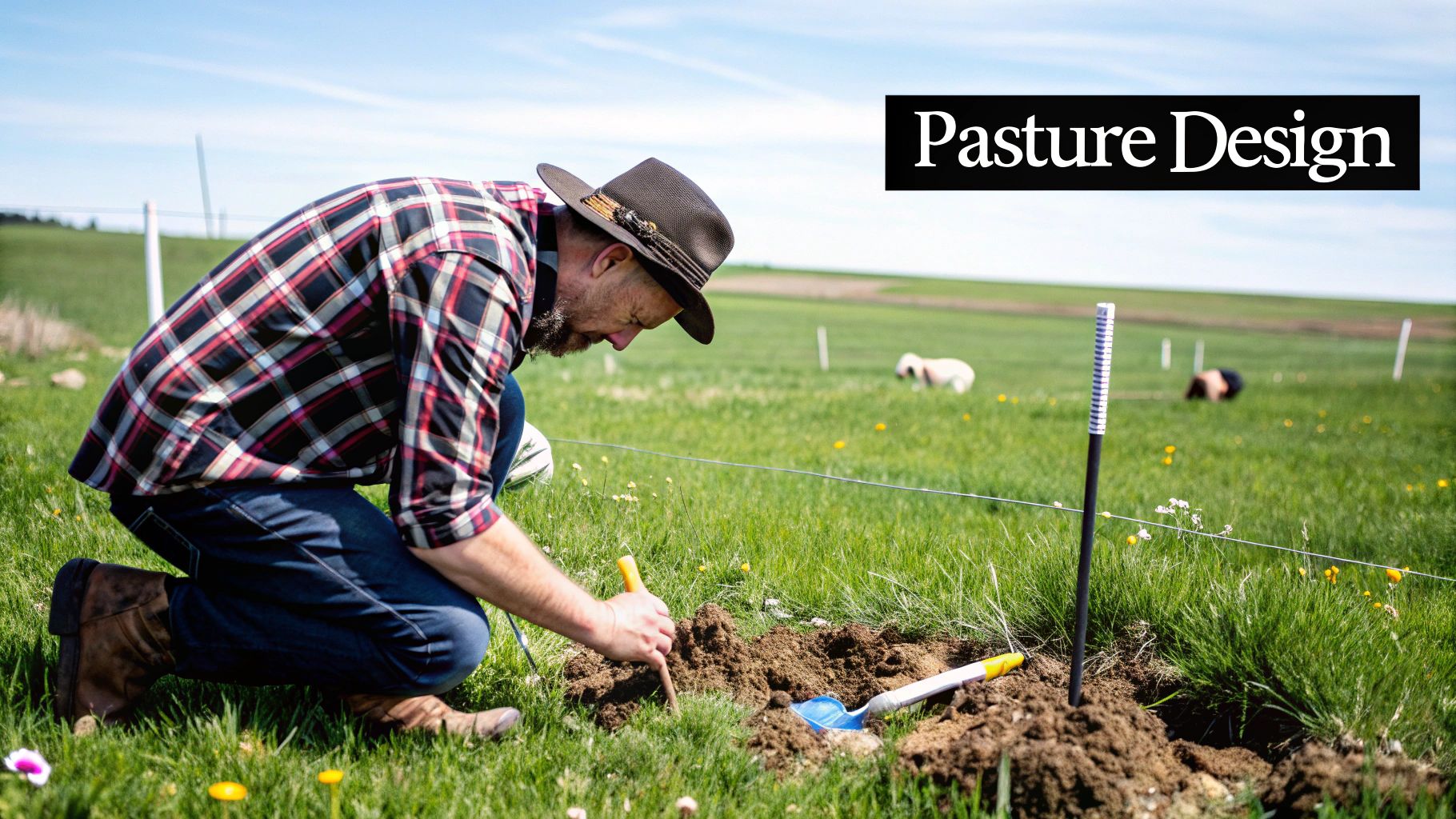
Your 5-acre pasture is the engine of your entire operation. It’s not just a field of grass; it’s a living system that directly fuels the health and growth of your grass-fed beef cattle. Cultivating a high-performance pasture is the single most important step for success on a small scale.
Start with Assessment:
Walk the Land: Before you buy seed or animal feed, know what you have. Are you seeing weeds, or do you have good existing forage like fescue or orchardgrass?
Get a Soil Test (Non-Negotiable): Your local extension office provides kits cheaply. This is your roadmap. It takes the guesswork out of amendments like lime or fertilizer, telling you exactly how to maximize the return on every dollar spent and boost soil health.
If your local extension office is slow or difficult to use, a highly accurate advanced home soil test kit can provide the essential pH and nutrient data you need to start building your forage foundation today.
Getting a soil test is your non-negotiable first step, as accurately detailed in this guide on Soil Fertility for Pasture Renovation from the Penn State Extension.
Building a Diverse Forage Foundation for Your Cattle
Once you understand your soil's needs, you can build a diverse forage base packed with nutrition. A single-species field is fragile. A healthy mix of different grasses and legumes, however, creates a resilient pasture that offers a balanced diet all through the growing season.
Legumes are a Game-Changer: Legumes like white or red clover are high in protein and act as natural nitrogen-fixers. They pull nitrogen right out of the air and deposit it into the soil. This single move reduces your reliance on commercial fertilizers, improving soil health year after year.
A great starter mix for many climates includes:
Perennial Ryegrass: Establishes quickly and is highly palatable for cattle.
Orchardgrass: A productive bunchgrass that holds up well to intense grazing.
White Clover: A low-growing legume that spreads well and performs that critical nitrogen-fixing function.

This combination gives you the solid nutritional foundation required for your beef cattle to thrive.
Pro Tip: Don't feel like you have to plow everything up. Look into "frost seeding" clover in late winter. You simply broadcast the seed over the frozen ground, and the natural freeze-thaw cycles work it into the soil for you. It’s a low-effort, high-reward technique for the small farmer.
Fencing and Water: The Foundation for Raising Grass-Fed Beef Cattle
With your high-performance forage plan in place, you need the infrastructure to support it. Good fence placement and easy access to water are absolutely critical for successful rotational grazing; the engine of your 5-acre operation.
1. Fencing: Secure Perimeter, Flexible Interior
For your 5-acre plot, a mix of permanent and temporary fencing is the most effective and cost-efficient strategy:
Perimeter Fence (Permanent): You must have a sturdy perimeter fence for security. Options like woven wire or multi-strand high-tensile are great. (High-tensile is generally cheaper to install but requires consistent maintenance and is often a better choice for beef cattle than dairy cattle).
Interior Fence (Temporary): Portable electric fencing is your best friend. It gives you the flexibility to create smaller paddocks and adjust their size instantly based on how the forage is growing and what your livestock needs.
To power your entire perimeter and ensure your cattle respect the temporary interior paddocks, a reliable, portable solar electric fence charger is a foundational piece of equipment that provides 24-hour protection.

2. Water: Constant, Clean Access
Cattle need constant access to clean, fresh water. If the water source is too far, they won't graze efficiently.
Ideal Setup: A central trough fed by underground lines that can serve multiple paddocks, saving you time and effort.
Budget Option: A large, durable, portable water tank that you can move easily with the herd. A little forethought here will save countless hours of hauling buckets.
Mastering Rotational Grazing on Your 5-Acre Ranch
If there is one secret to making a small acreage thrive, it’s rotational grazing. This method works with nature to keep your land healthy and your beef cattle fed throughout the growing season.
Continuous grazing: turning cows out into one big field is a fast track to:
Overgrazed patches.
Compacted soil.
Weed takeover.
Parasite problems.
Rotational grazing is the opposite. It divides your pasture into small paddocks. Your cattle graze one paddock intensely for a very short time (1–3 days) before being moved.
This simple act of moving the herd does the magic:
It gives the just-grazed pasture a critical rest period to regrow and deepen its roots.
The concentration of hooves, urine, and manure works organic matter back into the ground, acting as a natural fertilizer that builds rich topsoil and boosts soil health.
Setting Up a Paddock System for Efficient Beef Production
On a 5-acre plot, a simple four-paddock system is a fantastic, manageable starting point. You don't need permanent fencing for this—the flexibility of portable electric fencing is key.
Paddock Size: For a pair of finishing steers, a 1.25-acre paddock might give them enough to eat for about a week.
The Move: Once they've grazed it down, open a temporary gate and let them into the next fresh section. This keeps your animals on high-quality grass and prevents them from over-munching their favorite spots down to bare dirt.
The core principle is simple: graze short, rest long. Your cattle should eat the best part of the grass and move on, leaving enough behind for the plant to recover fully before they return. This cycle builds a resilient, highly productive pasture for your grass-fed beef.

As you can see, it’s a straightforward cycle of grazing and resting. This rhythm is what powers both pasture health and animal nutrition on a small farm.
Common Mistakes When Raising Grass-Fed Beef on 5 Acres
Even experienced homesteaders stumble early. Avoid these common pitfalls:
Buying cattle before fencing is finished. Livestock arrives faster than infrastructure. Finish fencing and water first.
Overgrazing too early. New pastures need recovery time. Grazing too short weakens root systems.
Underestimating winter feed needs. Running out of hay mid-winter is expensive and stressful.
Skipping mineral supplementation. Grass alone rarely provides complete trace minerals.
Moving cattle on a calendar instead of observation. Grass growth dictates movement—not dates.
Avoiding these mistakes can save years of frustration and thousands of dollars.
The Art of the Move: Reading Your Pasture and Your Cattle
Knowing exactly when to move your herd is the difference between good grazing and great regenerative agriculture. Don't follow a calendar; learn to read the signs your land and livestock are giving you.
Look at the Grass Height: The "take half, leave half" rule of thumb is your guide. Move your cattle when they’ve grazed the grass down by about 50%. This leaves enough leaf area for the plant to recover quickly during the rest period.
Check the Manure: Healthy, well-fed beef cattle on lush pasture produce loose, "pie-like" manure. If you start seeing it stack up or look dry, the forage quality in that paddock is dropping. It’s time for a move.
Watch Their Behavior: Are your cattle calmly spread out? They’re content. Are they bunched up, walking the fence line, or looking restless? They are telling the farmer they are ready for a fresh salad bar.
This is the straightforward cycle of grazing and resting—the rhythm that powers both soil health and optimal animal nutrition on a small farm.
For this example, we’ve divided our 5 acres into ten 0.5-acre paddocks for a pair of steers during the growing season:
Sample 5-Acre Rotational Grazing Schedule

This system of moving cattle every three days provides a nearly full month for the paddock to recover. This timing is flexible; you move faster during peak growth and slower when growth is reduced by heat or drought. The key is observation.
The Power of the Rest Period: Soil Health and Parasite Control
The rest period is where the real work of regenerative agriculture gets done. During the main growing season, a recovery time of 21 to 30 days between grazings is the target. This long break allows grasses to pull energy back into their roots, resulting in a much more robust and nutritious plant for the next cycle.
Two critical benefits of this long rest:
Increased Forage Quality: The grass recovers fully, increasing nutrient density and building soil health.
Natural Parasite Control: Internal parasite eggs are shed in the manure. By constantly moving the cattle to clean pasture, you break the cycle of reinfection. By the time the herd returns, sun and elements have killed off many larvae, naturally reducing the parasite load without chemical dewormers.
By constantly moving the cattle to clean pasture, you interrupt the life cycle of internal worms; the Missouri University Extension provides further research on Grazing Management for Parasite Control in grazing animals.
Choosing the Right Beef Cattle Breed for 5 Acres
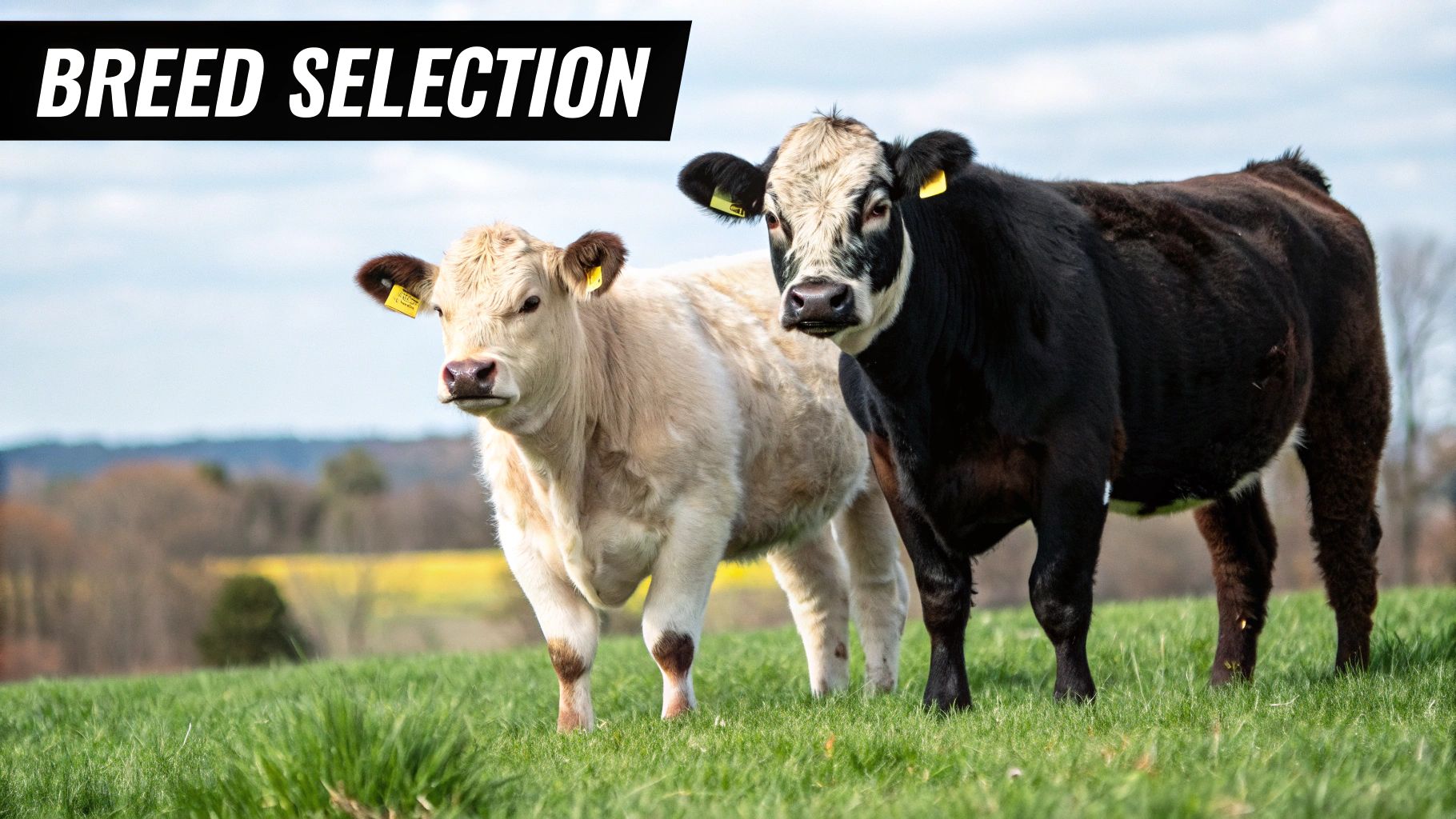
When you are aiming to raise grass-fed beef cattle on 5 acres, every choice matters—especially the breed. A massive animal bred for a feedlot is the wrong tool for this job. You need an animal that is an expert at converting grass into meat.
For small acreage, we lean into heritage and miniature breeds because:
They require less forage (less strain on the land).
They are naturally docile and easier to handle.
They finish well on a purely grass-fed diet.
A key takeaway for the new farmer is to match your animal to your environment, not the other way around.
Top Beef Cattle Breeds for Small Acreage
To successfully raise grass-fed beef cattle on 5 acres, your focus must be on breeds known for efficiency and grass-finishing ability. These heritage and miniature breeds are the smart choice for the small farmer:
Dexter Cattle: The gold standard for small-scale beef. These miniature Irish cattle are incredibly hardy, fantastic foragers, and produce beautifully marbled meat on a compact frame. They are perfectly suited for a 5-acre system.
Lowline Angus: A naturally smaller, concentrated version of the famous Angus. Lowlines were bred specifically for high-quality beef and superior feed efficiency on grass. You get an excellent meat-to-bone ratio without the massive appetite of their full-sized relatives.
Scottish Highland: Known for their calm temperament and ability to thrive on marginal pasture. Their shaggy coat means they burn less energy (and eat less feed) to stay warm during winter and cold snaps.
Starting Smart: For your first attempt, the smartest path forward is starting with two weaned steers (castrated male calves). This lets you avoid the complexities of calving, milk production, and managing a bull. You can pour all your focus into mastering pasture management and raising incredible grass-fed beef.
Grass-Fed Beef Timeline: What to Expect on 5 Acres
Grass-fed beef takes time. On a forage-only diet, most steers reach harvest condition between 18 and 30 months, depending on genetics, pasture quality, and climate.
Weaned calf arrival: 6–9 months old
Active grazing & growth: 12–20 months
Finishing on pasture: Final 3–6 months
Harvest weight: 900–1,100 lbs live weight (typical for small-frame breeds)
Grass-fed beef rewards patience. Slower growth produces denser nutrition and superior flavor.
Beyond the Breed: Essential Herd Health Basics
A healthy herd is built on a proactive system where sickness rarely takes hold. Your best defense is a great offense, driven by excellent nutrition and a clean environment provided by your rotational grazing plan.
Find a Local Vet: Build a relationship with a good large-animal vet before you need them. They will help you map out a baseline vaccination program for your area, covering common threats.
Natural Parasite Control: Your rotational grazing system is your top tool. By constantly moving the cattle to fresh pasture, you interrupt the life cycle of internal worms, drastically reducing the need for chemical dewormers.
Free-Choice Minerals: Always provide free-choice minerals. Even lush pasture can be short on essential trace minerals. A covered mineral feeder lets your livestock self-regulate, taking what they need to stay healthy and grow efficiently on grass.
To ensure your animals self-regulate their salt and essential mineral intake, place a simple, ready-to-use Red Trace Mineral Salt Brick in a covered area for continuous, free-choice access.
Our guide on the best beef cattle for homesteading offers more in-depth comparisons to help you decide which breed could be right for your acreage.
Planning for Winter: Year-Round Feeding Strategy
A lush summer pasture means nothing if you haven't planned for the dormant season. When you are operating on just 5 acres, a rock-solid winter feeding strategy is absolutely non-negotiable. This is where your financial forethought directly impacts your animals' health and your farm’s bottom line.
Winter Feeding Math: Forecasting Your Hay Needs
Running out of hay mid-winter is a costly mistake the serious farmer makes only once. The key to successful year-round management is forecasting your needs long before the heat leaves the air.
The simple math for feeding your beef cattle:
A mature cow or steer eats about 2% to 3% of its body weight in dry forage daily.
For a 1,000-pound animal, that's roughly 20 to 30 pounds of hay per day.
If you feed hay for 120 days, you need about 2,400 pounds (or roughly two large round bales, assuming a typical bale weight of 1,200–1,400 pounds. Bale weights vary significantly by region and moisture content, so always confirm actual weight with your hay supplier.) per animal.
Always add a 20% buffer to account for waste, trampling, and longer-than-expected winters.

Extending the Grazing Season: Stockpiling Forage
Before you break into your expensive hay supply, use a clever strategy to extend your growing season: stockpiling forage. For the small ranch or homestead, this is an absolute game-changer.
The process for saving on animal feed:
In late summer/early fall, fence off one of your best paddocks.
Pull the cattle out and let the grass grow, untouched.
After the first hard frost "cures" the grass, it becomes a standing haystack.
Strip-graze this forage by using temporary electric wire to give your livestock access to a fresh section each day.
This simple technique can easily add 30 to 60 days to your grazing season, making a huge dent in your hay costs and keeping your animals happier and healthier outside.
Grass-Fed Compliant Supplemental Feed
A true grass-fed beef cattle operation avoids grain. However, during an extreme cold snap, if you have a struggling calf or a sick cow, you need a compliant backup plan that still meets your principles.
In these short-term situations, look for high-quality, digestible fiber sources:
Alfalfa Pellets or Cubes: Highly palatable and packed with protein and energy. They add calories and nutrients without a single kernel of grain.
Beet Pulp: A "super fiber" that offers a slow-release energy source, excellent for helping cattle generate body heat. (Ensure you source a non-GMO, molasses-free version.)
These options are for short-term challenges, not a routine part of your feeding program. Your goal is always to have excellent pasture and high-quality hay as the foundation of their diet.
The Economics of Raising Grass-Fed Beef on 5 Acres
Turning all your hard work into a financially sustainable venture is key. We need to ensure your small farm is not just sustainable but profitable. This starts with understanding your costs.
The Initial Investment to Raise Grass-Fed Beef Cattle on 5 Acres
The first step toward profitability is calculating your initial investment. These are the one-time, start-up costs necessary to get your 5-acre ranch off the ground.
Your core start-up costs include:
Fencing: A secure perimeter fence (woven wire or high-tensile) is non-negotiable for safety. The interior, temporary electric fence system required for rotational grazing is significantly more affordable and flexible.
Water System: This could be a durable, portable water tank you move with the herd. For longevity, many farmers eventually opt for a more permanent system with buried lines and a central trough. Start simple, then upgrade.
Animal Purchase: The price for quality weaned steers or miniature breeds like Dexter cattle varies. Plan on investing a few thousand dollars for a pair of high-quality young beef cattle.
Calculating Ongoing Expenses and True Cost of Production
Once the infrastructure is set, your focus shifts to the recurring costs of keeping your livestock running smoothly. Budgeting for these annual expenses prevents nasty financial surprises:
Animal Feed (Hay): Likely your biggest expense, especially if you have long, cold winters.
Minerals: Free-choice minerals are a small but essential cost for herd health.
Vet Bills: Budget for vaccinations, dewormers (if needed), and unexpected issues.
Processing Fees: The cost to butcher and wrap the meat when your animals are finished.
Keeping a detailed log of every expense is crucial. It’s the only way to calculate your true cost of production and ensure you’re selling your premium product at a fair price. (For more tips on keeping these costs in check, check out our guide on homesteading on a budget.)
Profitable Sales Models for the Small Beef Producer
This is where the small farmer has a massive advantage. You are not competing with commodity feedlots; you are selling a premium product directly to consumers who value quality, sustainability, and transparency.
The key to financial success is the direct-to-consumer model:
Selling "Freezer Beef" by the Share: This is the most popular and effective method. Selling a whole, half, or quarter calf lets you secure a much higher price per pound than you could ever get at a traditional sale barn.
Selling the Story: You aren't just selling beef; you're selling the story, the superior quality of the grass-fed product, and the peace of mind that comes from knowing your cattle were raised using regenerative agriculture.
The market is strong: small producers who cut out the middleman can often get prices that are 20% to 50% higher than conventional meat.
Determining Your Price: Start by calculating your break-even point: Add up all your costs (startup and ongoing), and divide that number by the total pounds of finished beef you expect to yield. This gives you your cost per pound. From there, add a fair margin that reflects the premium nature of your grass-fed beef cattle product to ensure a profitable future for your small farm.
Legal Reality Check: Processing Grass-Fed Beef on a Small Farm
Raising grass-fed beef cattle on 5 acres is only half the equation—the other half is processing and sales compliance. In the U.S., beef sold to the public must be processed at a USDA-inspected facility. This allows the meat to be sold by the cut, through direct sales, or to restaurants.
Many small producers choose to sell freezer beef by the whole, half, or quarter, which can sometimes be processed under custom-exempt slaughter. In this model, the animal is legally owned by the buyer before processing, and the meat is not resold by the cut. Rules vary by state, so it’s critical to confirm local regulations before marketing beef.
Access to processing can be a limiting factor in some regions. USDA-inspected lockers may book out months in advance, especially during fall. Securing a processing date early is just as important as securing hay for winter.
Frequently Asked Questions About Raising Grass-Fed Beef on 5 Acres
Can you raise grass-fed beef without grain?
Yes. With high-quality pasture, proper rotation, and adequate winter hay, cattle can finish entirely on forage.
How long does grass-fed beef take to finish?
Most grass-fed cattle finish between 18 and 30 months, depending on breed and pasture quality.
Is 5 acres enough for a family’s beef supply?
Yes. One or two well-managed steers can easily supply a family with a year’s worth of beef.
Do grass-fed cattle need supplements?
Free-choice minerals are essential. Grain is not required, but minerals often are.
Is rotational grazing required on small acreage?
On 5 acres, rotational grazing isn’t optional—it’s the system that makes success possible.
At The Grounded Homestead, we are dedicated to providing the knowledge you need to grow your own food and live a healthier, more self-sufficient life. Visit us at https://thegroundedhomestead.com to continue your journey.

Facebook
Instagram
X
Youtube