
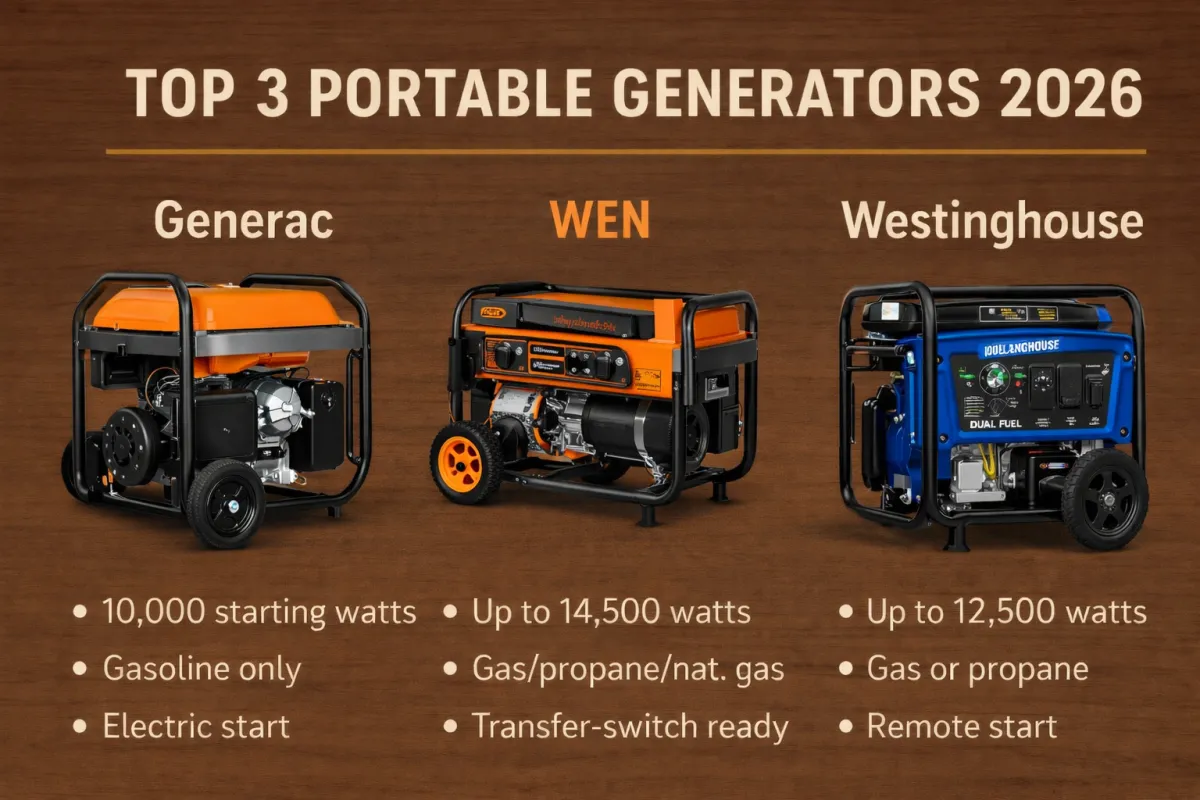
Top 3 Portable Generators for Homestead & Backup Power in 2026
Top 3 Portable Generators for Homestead & Backup Power
Portable, Tri-Fuel, and Dual-Fuel Options That Real People Rely On
If you’ve ever lost power during a winter storm, a summer outage, or right in the middle of getting something important done, you already know a generator isn’t a luxury — it’s insurance.
For homesteaders, rural homeowners, RV travelers, and anyone living a little farther from the grid, dependable backup power matters. Not just on paper, but in real conditions: cold mornings, long runtimes, heavy loads, and moments when you need the lights back now, not later.
Below are three generators that consistently come up in real-world conversations and buyer feedback. Each fits a different role — portable backup, fuel-flexible powerhouse, and heavy-duty home support — and each shines in its own lane.
In this guide, we compare the top 3 portable generators for 2026:
WEN 14,500-Watt 120V/240V Tri-Fuel Generator for Gas, Propane, and Natural Gas
Westinghouse 12500 Watt Dual Fuel Home Backup Portable Generator
We’ll cover specs, strengths, limitations, and who each model is best for. Plus a buying guide, FAQs, and our final recommendation.
Why Choose a Portable Generator Instead of a Standby System?
For most homesteads and rural homes, the real question isn’t “Do I need backup power?” — it’s “How permanent does that backup need to be?”
A standby generator is a fixed, whole-home solution. It’s powerful, automatic, and seamless — but it also comes with a high upfront cost, professional installation, permits, and ongoing service requirements. For some households, that makes sense. For many others, it’s more machine than they truly need.
A portable generator, on the other hand, offers flexibility without locking you into one setup.
Portable units can be:
Used during outages and seasonal work
Moved between home, shop, barn, or RV
Stored when not needed
Powered by different fuels depending on the model
Cost is a major factor too. A quality portable generator can deliver meaningful backup power — refrigeration, well pumps, lights, freezers, tools — at a fraction of the price of a standby system. For many families, that difference alone makes the decision.
There’s also control. With a portable generator, you decide when it runs, what it powers, and how it’s fueled. That matters if you’re planning for unpredictable outages, fuel availability, or future moves.
Standby systems shine when you want automation and whole-home coverage with no hands-on involvement.
Portable generators shine when you want versatility, affordability, and practical resilience.
For most homesteads, that flexibility wins.
Top 3 Portable Generators Compared
Generac 10,000 Starting Watt Portable Gas Generator – Provides 10,000 starting watts with electric start, designed for home backup or RV use. Built with a heavy-duty steel frame, offers a long runtime and relatively quiet operation for its class, and is 49-state compliant. Best for homeowners who want straightforward, reliable portable backup power without fuel complexity.
WEN 14,500-Watt Tri-Fuel Generator (Gas, Propane, Natural Gas) – Delivers up to 14,500 watts and can run on gasoline, propane, or natural gas. Transfer-switch ready with electric start, integrated wheel kit, and CO Watchdog safety shutoff. Best for homesteads and rural homes that value fuel flexibility and higher output during extended outages.
Westinghouse 12,500-Watt Dual Fuel Portable Generator – Produces 12,500 watts and runs on gasoline or propane, featuring remote electric start and transfer-switch readiness. Known for stable power delivery and convenience features that improve usability during storms or cold weather. Best for homeowners who want strong backup power with added comfort and ease of operation.
1. Generac 10,000 Starting Watt Portable Gas Generator

When people talk about dependable portable generators, Generac comes up fast — and for good reason. This 10,000 starting watt portable gas generator is built for homeowners who want serious backup power without committing to a permanent standby system.
What people like most:
Owners regularly mention how easily this unit handles essential household loads. Refrigerators, sump pumps, freezers, lights, and even well pumps fall well within its comfort zone. The electric start is a big win, especially in cold weather when pulling a recoil cord isn’t appealing.
The heavy-duty steel frame gives it a solid, durable feel. Many buyers comment that it feels like a machine built to last, not a disposable tool. Runtime is another highlight — when properly loaded, it keeps running steadily through extended outages without constant refueling.
Noise levels are often described as reasonable for its size. It’s not silent — no generator in this class is — but users say it’s far quieter than older, open-frame models they’ve owned.
Where some users hesitate:
A few reviewers mention the weight. This isn’t something you casually move around the yard without planning. While it’s portable, it’s better described as site-movable rather than something you’ll lift solo.
Fuel is another consideration. Because it’s gasoline-only, you’re dependent on fuel availability. During long outages or regional shortages, that matters.
Standout Features
10,000 starting watts suitable for essential home backup
Electric start with heavy-duty steel frame
Designed for home backup or RV use; 49-state compliant
Pros
Proven reliability and strong brand support
Straightforward gasoline operation with no fuel switching complexity
Solid power output for refrigerators, sump pumps, and basic household circuits
Cons
Gasoline-only limits fuel flexibility during extended outages
Heavy and bulky compared to smaller portable units
Not designed for quiet, inverter-style power (standard open-frame noise levels)
Best for:
Homeowners needing solid backup power
RV owners wanting high startup wattage
Folks who want proven reliability without complexity
Read the full review: GENERAC Portable Generator Review
2. WEN 14,500-Watt Tri-Fuel Generator

If flexibility matters to you, this WEN generator stands out immediately. It runs on gasoline, propane, or natural gas, which is a huge advantage in uncertain situations.
What people like most:
The biggest praise centers on fuel flexibility. Many owners like being able to hook into an existing natural gas line or switch to propane when gasoline isn’t available. That alone makes this generator feel more future-proof.
At 14,500 watts, it has no trouble powering large appliances, shop tools, and multiple household circuits simultaneously. It’s transfer-switch ready, making it a strong candidate for semi-permanent backup setups.
Users also frequently mention the CO Watchdog safety feature, which automatically shuts the generator down if carbon monoxide levels rise. That added safety layer brings peace of mind, especially for families running generators close to living spaces.
Where some users hesitate:
This generator is big — physically and mechanically. Some buyers mention setup takes longer, especially when switching fuel sources. It’s not complicated, but it’s not “plug-and-play” either.
A few users note that natural gas operation slightly reduces total output compared to gasoline. That’s normal with tri-fuel units, but it’s worth understanding up front.
Standout Features
Tri-fuel capability: gasoline, propane, or natural gas
High output (up to 14,500 starting watts)
CO Watchdog automatic carbon-monoxide shutdown
Pros
Excellent fuel flexibility for long-term outage planning
Transfer-switch ready for semi-permanent home backup setups
Strong wattage capacity for larger homes, shops, or multiple appliances
Cons
Larger footprint and heavier than standard portable generators
Reduced wattage output when running on natural gas
More setup complexity when switching fuel types
Best for:
Homesteads with access to natural gas or propane
Long-term outage preparedness
Users who value fuel security over simplicity
Read the full review: WEN Portable Generator Review
3. Westinghouse 12,500-Watt Dual Fuel Generator
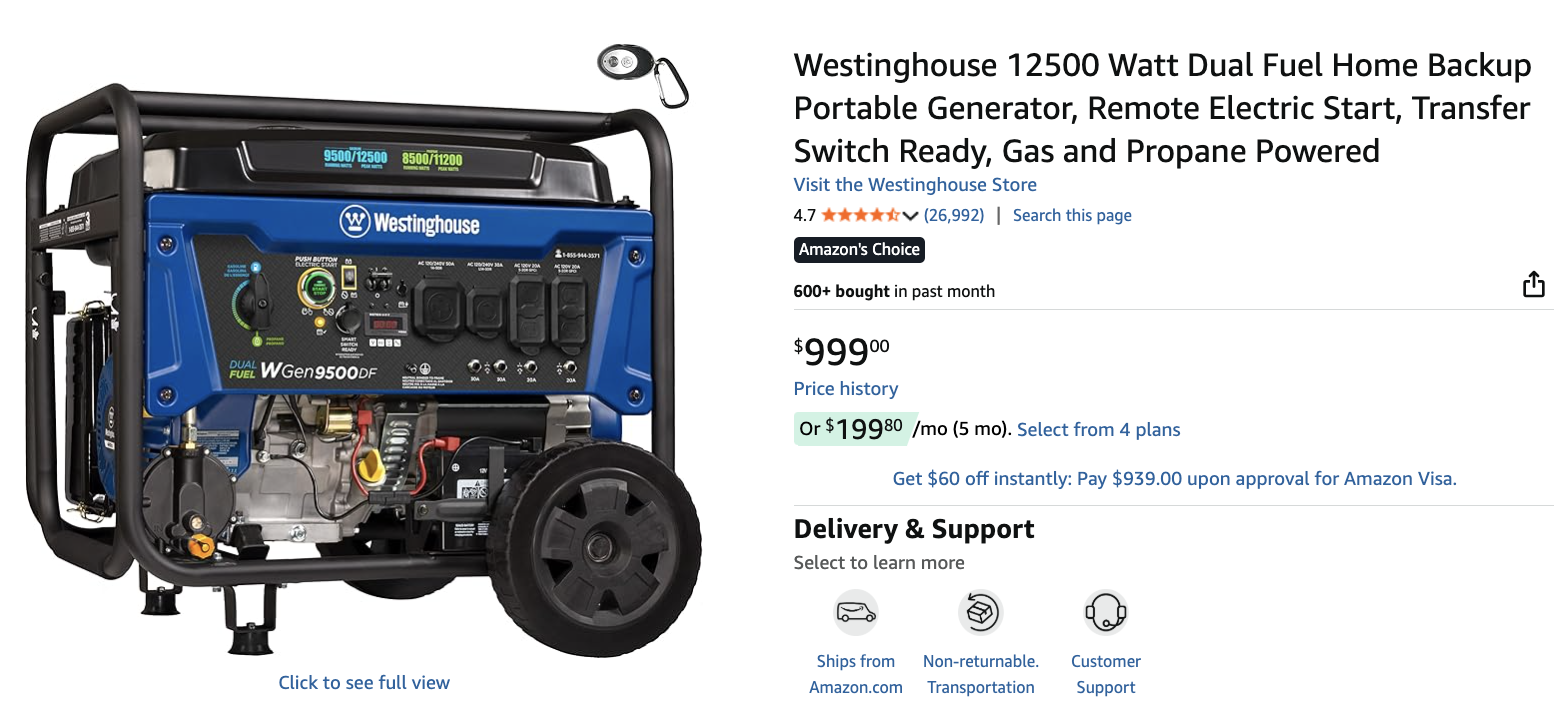
Westinghouse has built a strong reputation in the home backup space, and this 12,500-watt dual fuel generator fits squarely into that legacy.
What people like most:
One feature that comes up again and again is the remote electric start. Being able to start the generator from indoors during bad weather is more than a convenience — it’s a genuine quality-of-life improvement.
Users also appreciate the dual-fuel capability, letting them run either gasoline or propane. Propane users often mention cleaner operation and easier storage compared to gasoline.
The unit is transfer-switch ready, and many buyers successfully use it to power large portions of their homes during outages. Voltage stability and consistent output earn frequent praise.
Where some users hesitate:
A handful of reviews mention setup complexity during first use. Like many higher-output generators, it rewards careful setup and proper load planning.
Some users also point out that propane runtimes are shorter unless you’re using larger tanks — something to factor into outage planning.
Standout Features
Dual-fuel operation (gasoline or propane)
Remote electric start for convenience
Transfer-switch ready for home backup integration
Pros
Remote start improves usability during storms or cold weather
Propane option offers cleaner storage and easier fuel handling
Stable power output suitable for large appliances and multiple circuits
Cons
Propane runtime depends heavily on tank size
Initial setup can be time-consuming for first-time users
Still a heavy unit despite portability features
Best for:
Homeowners wanting remote start convenience
Dual-fuel flexibility without full tri-fuel complexity
Strong whole-home backup capability
Read the full review: WESTINGHOUSE Portable Generator Review
Buying Guide – How to Choose the Right Portable Generator
1. Power Output (Watts)
Start with the starting (surge) watts, not just running watts. Motors, well pumps, refrigerators, and freezers all need extra power to start. For most homesteads, 8,000–12,000 starting watts will cover essentials without overspending.
2. Fuel Type
Portable generators may run on gasoline, propane, natural gas, or multiple fuels.
Gasoline is easy to find but harder to store long-term.
Propane stores cleanly and doesn’t go bad.
Natural gas offers unlimited runtime but requires a fixed hookup.
Fuel flexibility matters during extended outages.
3. Runtime & Fuel Efficiency
Look at runtime at 50% load, not no-load numbers. Longer runtime means fewer refuels overnight or during storms. Larger fuel tanks or propane compatibility can make a big difference in real-world use.
4. Portability
Check the weight, wheel kit, and handle design. High-wattage generators are heavy, and portability often means “rollable,” not liftable. If you plan to move it between buildings, portability matters more than you think.
5. Noise Level
Portable generators are louder than inverter models, but some are noticeably harsher than others. Open-frame units prioritize power over silence. Consider placement distance from living areas and neighbors.
6. Safety Features
Look for carbon monoxide (CO) shutdown, low-oil protection, and clearly labeled controls. CO monitoring is especially important when running generators near homes, garages, or outbuildings.
7. Home Backup Compatibility
If you plan to power household circuits, make sure the generator is transfer-switch ready and supports 120V/240V output. This allows safe connection to a home panel without backfeeding the grid.
Price vs. Performance
WEN 14,500W Tri-Fuel Generator (~$1,000) – Best value on price for what you get. You’re paying slightly less while gaining tri-fuel flexibility (gas/propane/natural gas) and high starting wattage, which is rare at this price point. Biggest tradeoff is size/weight and a bit more setup complexity.
Generac 10,000W Portable Gas Generator (~$1,000) – Higher price for a simpler, gas-only platform. The value here is brand track record, straightforward operation, and a solid “no surprises” backup option — especially if you don’t care about propane or natural gas hookups.
Westinghouse 12,500W Dual Fuel Generator (~$1,000) – Similar price to the Generac, but you’re paying for convenience and flexibility: dual-fuel capability plus remote start. If ease-of-use matters (cold weather starts, storm nights), this often feels like the most “comfortable” ownership experience at the ~$1,000 tier.
FAQs
Q1: How big of a portable generator do I need for my home?
For most homes, 8,000–12,000 starting watts will run essentials like refrigerators, freezers, lights, sump pumps, and some HVAC components. Larger homes or well pumps may require higher output.
Q2: Can I safely run a portable generator during a power outage?
Yes, when used properly. Always operate generators outdoors, far from doors and windows, and use a transfer switch for home connections to prevent backfeeding.
Q3: Is propane or gasoline better for generators?
Gasoline provides slightly higher power output, while propane stores longer and burns cleaner. Dual- or tri-fuel generators offer the most flexibility.
Q4: Are portable generators loud?
Most high-wattage portable generators are louder than inverter models. Placement distance, barriers, and operating hours matter more than brand when managing noise.
Q5: Can a portable generator replace a standby generator?
For many homesteads, yes. Portable generators offer reliable backup at a lower cost, though they require manual setup and fueling compared to automatic standby systems.
Final Thoughts
Power outages don’t care about convenience, timing, or weather. They just happen. And when they do, having the right generator changes the experience entirely — from stress and scrambling to calm and continuity.
Most owners across all three models speak positively about performance, reliability, and value. The key difference isn’t quality — it’s fit. Your fuel access, load needs, and how hands-on you want to be should guide the decision.
If backup power matters where you live, any one of these generators is worth a serious look.
Final Recommendation
If you want maximum fuel flexibility at the lowest upfront cost, the WEN 14,500W Tri-Fuel Generator is hard to ignore. Being able to run gasoline, propane, or natural gas at roughly the $800 mark makes it especially appealing for homesteads planning for longer outages or uncertain fuel availability.
If you value simplicity, brand reputation, and straightforward operation, the Generac 10,000W Portable Generator is a solid, no-nonsense choice. It costs a bit more, but many homeowners are comfortable paying for Generac’s long track record and familiar design.
And if convenience and ease of use matter most—especially during storms or cold starts—the Westinghouse 12,500W Dual Fuel Generator stands out. Remote electric start and dual-fuel capability make ownership feel smoother, even at a similar price point to the Generac.
Amazon Links:
Amazon Link: WEN 14,500W Tri-Fuel Generator
Amazon Link: Generac 10,000W Portable Generator
Amazon Link: Westinghouse 12,500W Dual Fuel Generator
At the end of the day, the “best” generator isn’t about brand loyalty—it’s about matching fuel access, power needs, and how hands-on you want to be when the lights go out.
Disclosure: Links on this page may be affiliate links. This means a commission may be earned at no extra cost to you. Thank you for your support!


Facebook
Instagram
X
Youtube